Every strong physique begins with the chest, the core of your upper-body power. Whether you’re at home, in the gym, or just starting out, this chest workouts for beginners guide helps you build strength, shape, and confidence right from home or the gym.
Most beginners think chest workouts require heavy weights. The truth? Your body weight is enough to create power when used correctly.
This FitPlay guide takes you through each move from basic to advanced, so you can train confidently and safely.
Push-Ups: The Foundation of Chest Workouts for Beginners
When it comes to a chest workout for beginners, nothing beats the classic push-up. It’s the simplest yet most effective move to activate your entire upper body, chest, shoulders, triceps, and even your core.
Most people underestimate push-ups, but they’re not just an exercise; they’re a benchmark of strength. You don’t need a gym or equipment, just proper form and consistency.
Here’s how to master them:
- Keep your hands slightly wider than shoulder width.
- Maintain a straight body from head to heels.
- Lower your chest close to the floor slowly and push back up with control.
Start with 3 sets of 10 reps. If that feels tough, begin with knee push-ups or wall push-ups. Every rep counts when you’re learning control.
FitPlay Tip: Focus on depth and form over speed. A slow, clean push-up builds more strength than ten sloppy ones.
Once you’re comfortable, aim to increase reps weekly, and your endurance and muscle definition will follow naturally.
The Incline Push-Ups, Soft Power to Start With
All a novice requires is a gradual initiation into chest training, and incline push-ups are the most appropriate to begin with. They also decrease the resistance of the body weight and yet attack your chest successfully, more on the upper chest muscles, which are important to the shape and definition.
This is an intermediate exercise between a beginner and intermediate workout, in case you cannot do the usual push-ups. Everything you want is an elevated surface, bed edge, solid table, or even a bench.
Here’s how to do it right:
- Put your hands on the raised part, at a distance from your shoulders.
- Bend backwards until you are in a straight line, body: head to heels.
- Lift up your chest and make it as close to the surface as you can.
- Push up with a stabilizer- do not hurry with the movement.
Complete 12 reps in 3 sets, with a 30-45 second rest period between sets.
FitPlay Tip: The slower the repetitions you make, the more muscle fibers you will be using. It is not about some speed; it is about control.
The incline push-ups will help you learn a correct set of body positioning, train your shoulders, and be ready to do regular or decline push-ups in the future.
The Foundation Builder: Dumbbell Chest Press
When your body is acclimated to the push-ups, it is time to add controlled resistance, and the dumbbell chest press comes in.
This is one of the finest exercises that can be used in any chest exercise in which a beginner is starting since it helps to build strength as well as size and condition the body to move about in the best way it can.
You can do it either in your home or in the gym; you will only need a flat surface and a pair of dumbbells (the filled water bottles can even be used in the beginning).
The following is the way to do it:
- Lie on your back on a mat or on a bench.
- Place a dumbbell in your hands and have your palms up.
- Maintain your elbows at a little lower position as compared to your shoulders.
- Press both to the upwards position until your arms reach their full length.
- Roll them down gradually in the starting position.
Aim for 3 sets of 10-12 reps. Concentrate on moving steadily and in control; do not bang the dumbbells or lock your elbows.
FitPlay Tip: It matters how you breathe. Breathe in when you are reducing the weight, and when lifting it, breathe out. This beat will assist your muscles to work to their best advantage and avoid stress.
The dumbbell chest press not only creates strength, but it is enhances the symmetry, posture, and stability of the chest. In the long run, it will have the look of the chest being broader and stronger.
Chest Dips (Beginner Version)
Dips are often regarded as advanced in terms of chest-building exercises, but with a variation, they can be used as a great option in a chest workout for a beginner.
The dips concentrate on the lower section of your pectoral muscles, which gives shape and a thickened appearance to your chest.
First of all, you do not require a gym machine. Two strong parallel surfaces can be used, such as chairs, bed corners, or kitchen counters, as long as they are strong enough to support your weight.
Here is the method of performing dips with somebody, not that intense:
- Your hands are on two parallel surfaces that have edges.
- Keep your arms straight and place your feet upon the ground.
- Bend forward a little, a bit, this motion is aimed at the chest, rather than the triceps.
- Half down (but not too far) forward, then press yourself up with a smooth motion.
Perform 3 sets of 8-10 reps. Work more and more deeply, taking more reps.
FitPlay Tip: The neck should be kept in a neutral position and the shoulders in a relaxed position at all times. Do not shrug or swing your body to gain momentum; strength is built up by controlling, not speed.
The chest dips use various muscles simultaneously, which enhances your power in the upper body and also narrows your chest line. They are especially good for individuals who are out to achieve a sculptured lower chest without using heavy machines.
Wall Push-Ups, Absolute Beginners
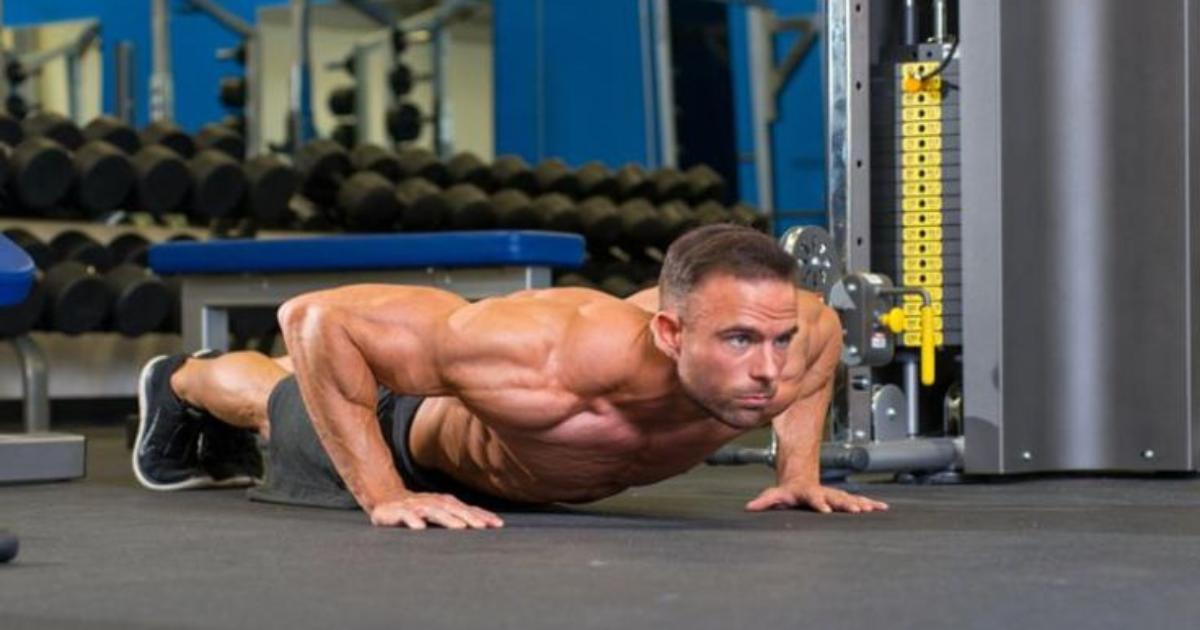
Wall push-ups are the best beginner’s chest workout by offering the most comfortable place to begin your physical fitness regimen after an extended break or a complete lack of this activity.
They will assist you in knowing the right exercise of push-ups and ensure that the correct pressure on the joints is minimal, perfect for those who are just starting to train.
It might seem that wall push-ups are easy moves, but they are effective in mobilizing your chest, shoulders, and arms, and they do it without any effort. They also help a lot to develop balance and form, and then transition to floor exercises.
The following is the way to do them properly:
- Facing a wall, disengaged, one arm’s length.
- Keep your hands against the wall, flat with your shoulders and shoulders apart.
- Your legs should be slightly apart so as to stand up.
- Elbows should be bent slowly, and your chest should be bent towards the wall.
- Control Push-off to the starting position.
Complete 3 sets of 15 reps. You will get the sensation of your chest tightening when you simply move like this.
FitPlay Tip: Concentrate on your breaths, breathe in as you run and breathe out as you run. This develops control and rhythm, which roll on to more complicated variations of push-ups.
As you become stronger, move your feet farther and farther away as they become more difficult. Before long, you would be prepared to do incline or regular push-ups already with strength and proper form.
Fly with Dumbbells, Strength, and Stretch
The dumbbell fly is a great form of isolation exercise in a chest workout when one is starting off. It mainly works on inner and outer chest muscles, allowing you to build shape, definition, and flexibility simultaneously.
As compared to presses or push-ups, which are more power-oriented, the fly is more stretch and contract oriented, and this results in the round, shaped look of your chest. It can be done by beginners who would like to experience the chest directly and not strain their shoulders to do so.
The following is how to do it in a safe manner:
- Lying flat on a mat or a bench with a dumbbell in either hand.
- Have a slight bend in your elbows; do not make them straight.
- Keep your arms above your chest, and palms facing one another.
- Raise your hands slowly in a broad curve until you can sense a light stretch over your bosom.
- And pull your arms up and squeeze your chest at the top.
- Perform 3 groups of 10-12 reps; put emphasis on the smooth, controlled movement. It is not important to lift heavy, but rather to stretch and shorten the muscle.
FitPlay Tip: You should be slow in your movements. Think about hugging a giant tree; that is what you want to do. This is a psychological stimulus that will engage your chest more and exert less strain on your arms.
The dumbbell fly strengthens your chest, besides enhancing the shoulder motion, posture, and general mastery throughout your other upper body workouts.
Turn Down Push-Ups, Take It to the Next Level
After knowing the standard and incline push-ups, you should test your strength and balance with the decline push-ups.
It is a highly developed form of the chest exercise that is necessary for a beginner who is willing to take it to the next level. It gives more attention to the upper chest and shoulders, to make them look fuller and lifted, as many people want.
Decline push-ups can be done in any location; all you have to do is have an elevated surface such as a chair, low bed, or bench.
Here’s how to do it correctly:
- Rest your feet on the higher surface, and your hands on the ground, at the shoulders, and in the same manner.
- Keep straight, head, heels, no sagging of the hips.
- Bend down on your chest towards the ground.
- Press up until your arms are straight in an extended position.
Perform 3 sets of 8-10 reps. Although it is only body weight, the angle makes the exercise really difficult.
FitPlay Tip: During the movement, your core has to be tight. Many people think that a strong core is not only a way to protect the lower back of a person, but also enhances balance and chest activation during each repetition.
Decline push-ups develop strict power and contour in all parts of the upper body. They are evidence that you can achieve tangible progress only with your own body weight – there is no need to use heavy gym devices.
Chest Press Strength Without Weights Resistance Bands
Resistance bands can never be defeated when it comes to versatility and convenience in the training of a beginner who is at home.
The resistance band chest press imitates the action of a dumbbell press or machine press, which provides your muscles with tension on the total extent of movement.
It is that constant pressure that makes it a great addition to any chest exercise of beginners.
It is an ideal step to take when one lacks the gym equipment or wishes to gain strength but avoids the risk of overloading his/her joints.
Here’s how to perform it:
- Support the band at the back of you at breast height – on a door, pole, or stable object.
- Take a handle in each palm, but with the palms facing down.
- Take a small step forward to put some tension on the band.
- Bend forward using both arms until extended.
- Gradually go back to the starting position, maintaining the same control.
Perform 3 sets of 12-15 reps. The resistance band must also be hard, yet not painful, and increase or decrease tension by stepping either forward or backward.
FitPlay Tip: It is a mistake to allow the band to snap. The second one is to control the return phase- that has the greatest muscle-building magic.
It is a good workout that enhances endurance, posture, and muscle coordination. It is also easy to carry around and hence fits well into the hands of individuals who desire to remain consistent without the need of having a gym set up.
Also, if you want to strengthen your back at home without heavy equipment, you can check our other work here.
The Strength Standard, Bench Press
When it comes to classic chest training, there is one move that characterizes it, and that is the bench press.
It has been the exercise of choice over the decades to grow a strong, thick, and balanced chest.
Although this may sound easy, it is a type of movement that requires precision, control, and patience, hence an essential stage in any chest exercise routine among novices.
The bench press mainly works on your pectoralis major, but it also works your shoulders and triceps, which will be able to build your strong base in your upper body.
It is done in the following way:
- Sit on a bench, lying on your back with your feet firmly planted on the ground.
- Grab the barbell with a space that is slightly greater than the shoulder.
- Keep your body straight and your belly tight.
- Bring the bar down gradually until it is barely above your chest – bouncing will not help.
- Keep pushing and pushing until your arms are straight.
Begin with 3 exercises of 8-10 repetitions of light to moderate weight. Become familiar with the form, then add more weight.
FitPlay Tip: Do not feel like lifting heavy. Power is achieved by restraint and discipline, rather than pride. With the right shape, even the medium weights will bring enormous results in the long run.
The bench press will teach you balance, muscle coordination, and brute pushing power, all of which will transfer to all the other upper-body exercises that you will undertake in the course of your fitness program.
Stretch and Recover: The Lost Secret of Growth
All good chests are not made by pulling or pushing – they are made by good recuperation and elasticity. The biggest mistake that most beginners commit is neglecting stretching after the workout, yet that is what makes your muscles grow, mend, and maintain their injury-free state.
Once you have finished your chest exercise as a beginner, your muscles require time and space to heal the micro-tears that have been created due to exercising. That is how true growth occurs – not in the exercise, but in the post-exercise.
The following is how to have a massive chest:
Doorway Stretch: Stand by one doorframe, thread your forearm against the door frame at a 90-degree angle, and lean forward slowly until you notice the stretch on your breast. Hold for 20-30 seconds on each side.
Wall Stretch: This is done by ensuring that you apply your hand flat on a wall and gradually twist your body to the opposite direction. This stretches further and eases the tightness of the shoulders.
Deep Breathing: Breathe slowly and fully with stretching, which enhances the flow of blood and relaxes your body.
Will these stretches be done after each of the chest sessions or on rest days? It enhances muscle pliability, helps recovery, and alleviates pain.
Word of Advice: Never be in a hurry to warm up. Strength is manifested in recovery. Rest your muscles there, due- constants and regularities are always better than expedients.
Stretching is a perfect way to finish your workout and prepare your body for the new one. It is the shortest step most people forget about, though it is the step that leads to gradual improvement and effortlessness of one step over another.
And with all these workouts, the meal preparation is also important. You can check our other blog to learn how you can easily prepare healthy meals at home without wasting much time.
FitPlay Quick Answers
Q1: What should be my chest training frequency as a beginner (when it comes to the number of days a week)?
A beginner should exercise two or three times a week. Muscles require a rest period to recover and develop, and you do not want to train your chest on consecutive days. Your chest exercise can be combined with such other muscles as shoulders or triceps, though you should always provide your body with at least a day of rest between intensive ones.
Q2: Am I required to go to a gym facility to do some chest workouts?
Not at all. The beauty of this exercise is that most of the exercises can be performed at home using their body weight, dumbbells, or resistance bands. A gym is one of the things that can later be incorporated to add variety; however, it is not a prerequisite for a strong and shaped chest.
Q3: What will be the time taken before I can realize visible results?
Through the correct consistency, form, and nutrition in place, you will begin to feel stronger in 3-4 weeks and defined in about 6-8 weeks. Everybody reacts in a different way, yet progress is progress in any direction, not speed.
Question 4: Is it a good idea to perform all 10 exercises in a session?
No, you don’t need to. Select 4 -6 exercises per your level and time. As an illustration, begin with wall push-ups, incline push-ups, dumbbell press, and resistance band chest press. When you get better, substitute push-ups and dips with more difficult exercises.
Q5: When is the most suitable time to exercise your chest?
There is no specific time of the day that is the best one, and it is about consistency. Morning exercise enhances daily energy, whereas evening exercises reduce stress. The most convenient time is the time that one can commit to.
| Exercise | Equipment Needed | Sets | Reps | Focus Area |
|---|---|---|---|---|
| Wall Push-Ups | None | 3 | 15 | Chest Activation |
| Incline Push-Ups | Bench/Table | 3 | 12 | Upper Chest |
| Push-Ups | None | 3 | 10 | Overall Chest |
| Dumbbell Chest Press | Dumbbells | 3 | 10–12 | Mid Chest |
| Dumbbell Fly | Dumbbells | 3 | 10–12 | Inner Chest |
| Resistance Band Press | Bands | 3 | 12–15 | Full Chest |
| Chest Dips | Chairs/Bars | 3 | 8–10 | Lower Chest |
| Decline Push-Ups | Elevated Surface | 3 | 8–10 | Upper Chest |
| Bench Press | Barbell | 3 | 8–10 | Strength |
| Stretching | None | — | — | Recovery |

Conclusion
It does not mean that you have to use complex devices or even several years of training to build your chest; you only need a resolution, a shape, and a strategy that will suit you.
This easy chest workout was meant to be structured as well as motivating, doing a mixture of home and gym workouts, so you do not need to be at the gym to begin; you can start anywhere.
Also, it is important to keep in mind that each repetition is a message to your body that you are willing to get stronger.
Push-ups, dumbbells, and resistance bands might be considered simple; however, it is strong, and they can be carried out consistently and with concentration. You do not have to be lifting heavy, but be intelligent.
Your chest is going to increase, your power will increase, and confidence will come.
Perfection is not the point, but you still need to arrive, one workout at a time.
“Your chest doesn’t grow from lifting heavy; it grows from lifting with heart, focus, and consistency.”
Want to dive deeper into how chest workouts actually build strength and function? Explore a trusted health and fitness guide by Harvard Medical School that breaks down every movement with science and clarity.